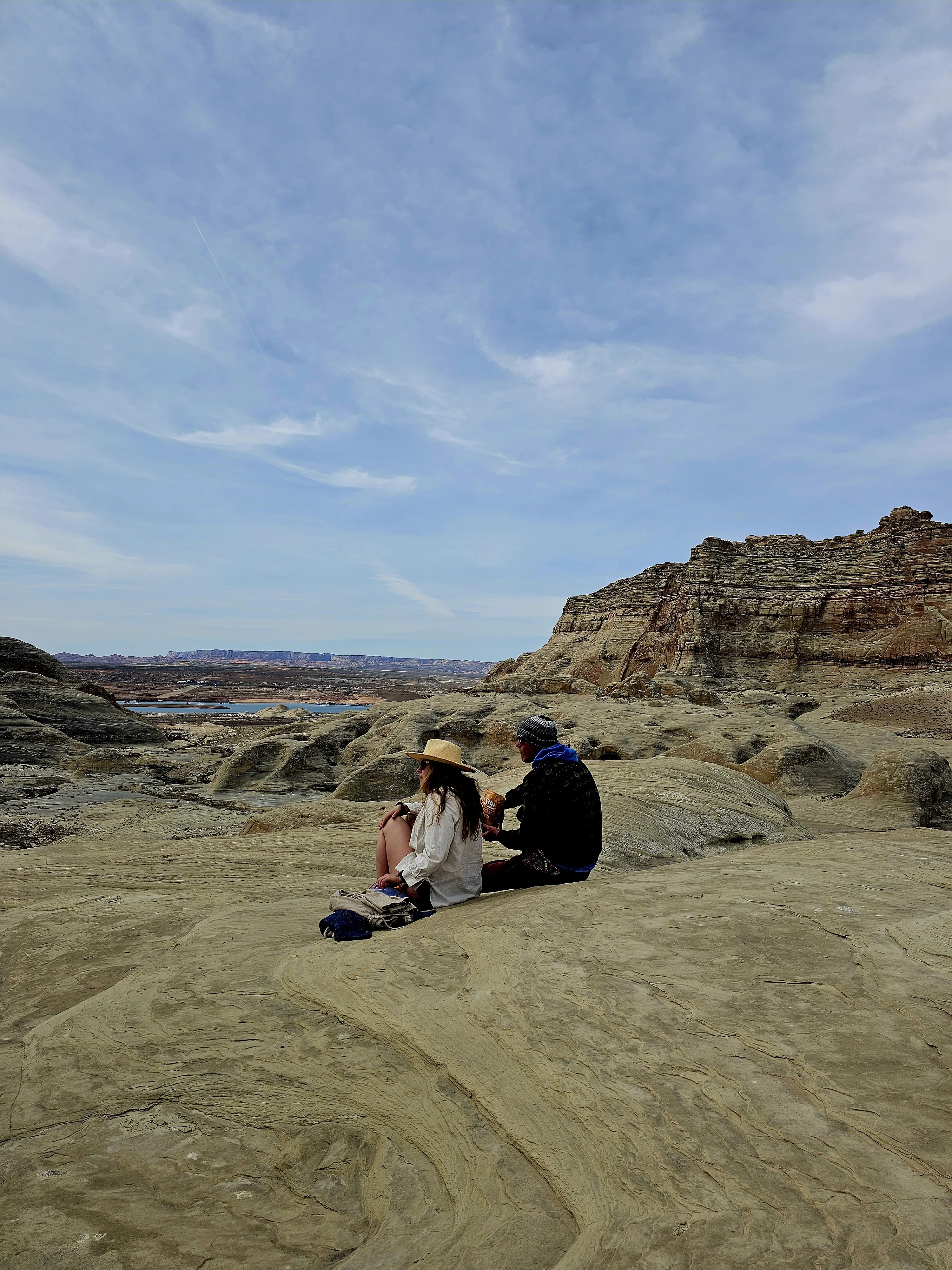
There is a haunting kind of silence in Glen Canyon these days.
Not the silence of death.
The silence of something waiting.
If you spend enough time moving through the desert Southwest, really moving through it, not just stopping at overlooks and marinas, you begin to notice things. Tiny shifts. Cottonwoods returning where bare mud once baked in the sun. Water seeping again from canyon walls. Dragonflies where there were none a few years ago. The smell of wet earth after decades underwater.
Life creeping back into places we were told were gone forever.
And somewhere in that silence, standing along the retreating shoreline of Lake Powell, I keep returning to the same thought: What if Glen Canyon was never supposed to be drowned in the first place?
For decades, Americans were taught that Glen Canyon Dam represented progress. Human ingenuity. Stability in the desert. A triumph over scarcity itself.
Hold the river. Hold the water. Hold certainty. Hold growth forever.
But deserts have a funny way of humbling people who believe they can out-negotiate nature.
The tighter we grip the Colorado River, the more fragile everything seems to become. Reservoirs shrink. The shoreline retreats. Dust storms rise. Ecosystems weaken. The legal battles intensify. The fear grows louder every year.
And perhaps most ironic of all, the more we tried to hold onto the water, the less alive the system became.
I often say Lake Powell exists to teach us a lesson: The more tightly we cling to things, the less we actually have.
Because rivers survive through movement. A healthy river does not hoard water. It carries it. Floods with it. Shares it. Releases it downstream to cottonwoods, wetlands, side canyons, aquifers, birds, fish, soil, and life far beyond its banks.
Flow is what creates abundance. Stillness, eventually, creates stagnation.
And beneath the still waters of Lake Powell lies one of the greatest ecological and spiritual losses in modern American history: a drowned canyon system many once believed rivaled, even surpassed, parts of the Grand Canyon in beauty. A lost American landscape. A lost national park.
Before inundation, Glen Canyon was not barren wasteland. It was a labyrinth of living sandstone cathedrals, hidden springs, hanging gardens, warm silty riverbanks, cottonwood groves, wildlife corridors, and side canyons so impossibly beautiful that those fortunate enough to know them spoke of them with something close to reverence.
Katie Lee mourned the canyon like a lost love. Edward Abbey warned of the arrogance of believing every wild thing exists to be conquered by concrete.
Perhaps they understood something we are only beginning to realize ourselves. Landscapes are not scenery. They are living systems. And living systems shape climate.
Modern conversations about drought and climate tend to focus on emissions and temperature charts. Those conversations matter. But I can’t help wondering if another piece of the puzzle has been overlooked. What happens when you drown hundreds of miles of riparian habitat in the middle of a desert? What happens when warm flowing rivers become stagnant reservoirs? When springs disappear beneath cold water? When floodplains stop flooding? When wetlands vanish? When living soil suffocates? When entire biological corridors stop breathing?
Plants release moisture into the atmosphere. Trees cool the land. Wetlands stabilize temperatures. Living ecosystems influence humidity, groundwater recharge, localized weather, and even the conditions that help storms develop.
Life participates in rain.
So what happens when life disappears? Maybe the desert loses more than beauty. Maybe it loses part of its atmospheric memory.
Maybe that sounds like a bold idea. But then you stand in Glen Canyon today. You watch cottonwoods emerging from freshly exposed sediment. You hear frogs returning. You find dragonflies dancing over water that has only recently seen sunlight again. You smell life returning.
And suddenly the question doesn’t seem quite so unreasonable.
Because Glen Canyon is returning. Not metaphorically. Literally.
As water levels fall, buried springs are resurfacing. Native vegetation is reclaiming exposed ground. Wildlife is moving back into corridors that have been underwater for decades.
The canyon does not emerge dead. It emerges alive. Waiting. Patient. As though the desert itself has been holding its breath beneath the reservoir all these years.
And this is where the conversation becomes uncomfortable. Because once people witness this re-emergence with their own eyes, another question naturally follows: What if restoration is actually possible?
Not chaos. Not collapse. Not simply tearing down a dam. But evolving beyond an outdated idea of what progress looks like.
The world that built Glen Canyon Dam no longer exists. Hydroelectric power was once revolutionary technology. Massive reservoirs once appeared to be the only answer to water security in the American West.
But humanity is no longer limited to the solutions of the 1950s. Today we have advanced solar infrastructure, decentralized electrical grids, battery storage, geothermal energy, smarter water management, aquifer recharge science, and modern run-of-the-river hydropower systems capable of generating electricity while preserving the natural movement of rivers.
The Southwest itself possesses some of the greatest solar potential on Earth. Meanwhile, we continue losing enormous amounts of water every year to evaporation from giant reservoirs exposed beneath the desert sun while calling that efficiency.
Perhaps the question is no longer: How do we dominate the river? Perhaps the better question is: How do we partner with it again?
This isn’t an argument against people. It isn’t an argument against progress. It’s an argument that true progress should evolve.
No concrete wall can replicate the complexity of a living canyon. No reservoir can replace biodiversity. No engineering project can recreate natural sediment transport, floodplain renewal, thriving riparian ecosystems, or the quiet wonder of paddling through sandstone corridors alive with birdsong and cottonwoods shimmering after rain.
Wonder matters. Belonging matters. Living places matter.
For too long, the conversation surrounding Glen Canyon has been framed as a false choice: Keep the dam or lose civilization. But rivers sustained life throughout the Southwest for thousands of years before Glen Canyon Dam existed. The Colorado River was never simply plumbing. It was the circulatory system of the desert.
Perhaps what we are witnessing now is not merely the decline of a reservoir, but the unraveling of an old philosophy: the belief that control is the same thing as wisdom.
The canyon beneath Lake Powell is teaching us something different. It is teaching us that life returns when flow returns. That ecosystems know how to heal if given the opportunity. That the desert remembers.
And perhaps America is being offered something extraordinary: the opportunity to participate in one of the greatest ecological restoration projects in modern history. The return of Glen Canyon. The return of America’s lost national park.
Not through anger. Not through ideology. But through courage. Curiosity. Science. Storytelling. And the humility to admit that sometimes the greatest act of progress is not building something new, but allowing something ancient to live again.
Because beneath the waters of Lake Powell, the canyon still breathes. And if you listen closely enough, it sounds like it’s calling us home.